
Finding Pompeii
In the early 1700s, Charles VII of Bourbon sent a team to dig for sculptures to decorate his new palace. This became a regular expedition at the nearby town of Herculaneum, which was buried alongside Pompeii. In 1748, Pompeii began to be uncovered.
At the time, they didn’t know that it was Pompeii they had discovered. But, because of the way it had been buried, work moved there. As the wind had started in the direction of Pompeii during the eruption, Pompeii was mainly buried by loose small stones (lapili), with the pyroclastic flow forming a smaller layer on top, whereas Herculaneum was buried by the first and hottest pyroclastic flows, with less lapili, making its covering much more compact and harder to dig through.
For a while, unorganised excavations continued. The excavators would remove valuable treasures and artworks, and then refill the area. This included cutting sections of frescoes off their walls, and sometimes destroying the rest of the wall paintings to increase the worth of the ones taken.
In 1763, an inscription was uncovered outside the Porta Ercolano that confirmed the town as ‘Pompeii’.
Excavating Pompeii
After this, the excavations stopped being filled in and were instead left open to be viewed. Unfortunately, this meant the uncovered areas of the city were now open to wind, rain, and looters, no longer protected by the earth. The structures and paintings started to rapidly deteriorate and many are completely faded today.
In the 1800s, with Italy under the French control of Napoleon Bonaparte, the workforce at Pompeii was expanded and uncovered the rest of the city walls and the amphitheatre. When the Bourbons reclaimed control of Italy, work slowed but maintained a steady pace, and the land above Pompeii was gradually bought up to allow further excavations.
In 1863, Giuseppe Fiorelli was made superintendent of Pompeii. He implemented a more organised and systematic excavation, and organised the city into the regions used today. He split Pompeii into nine regions, inside each of which were numbered city blocks. Each doorway along a block was then numbered, giving a system which allowed easy categorisation and location of any building or artifact.
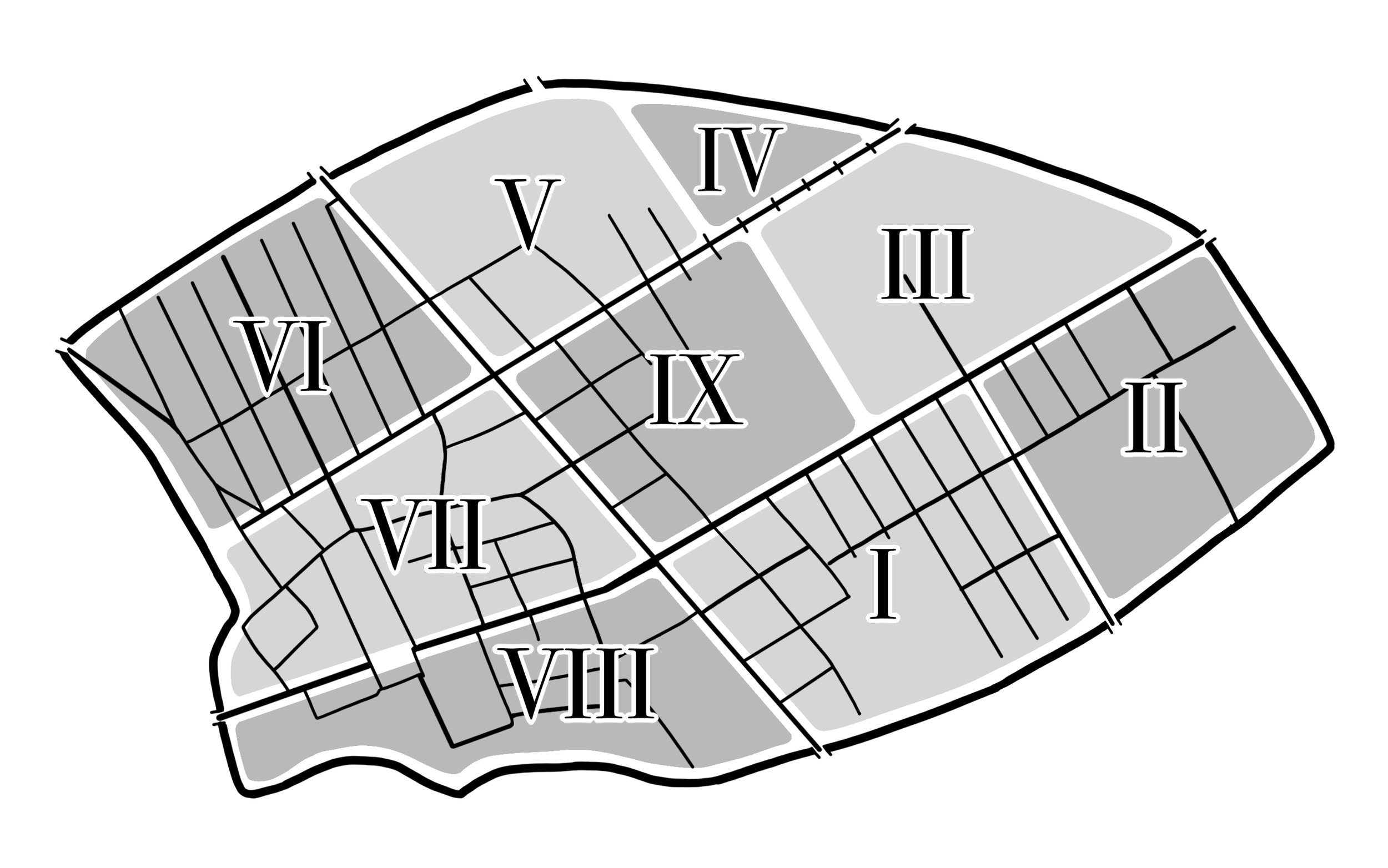
Fiorelli revised and published the excavation records of Pompeii in the ‘Pompeianarum Antiquitatum Historia’, and opened research to the world beyond Italy.
Fiorelli also developed a technique that characterises Pompeii to this day - the plaster casts. This was most famously used to preserve the shape of victims of the eruption, but was also used on organic matter such as wood. You can read about this technique in more detail here.
During this time research flourished, and towards the end of the 1800s, August Mau developed a categorisation of Pompeian wall paintings that identified different styles and split them into sections of a historical timeline that began to reveal the history of Pompeii beyond its famous last days.
By 1909, the whole of the land above Pompeii had been bought back by the state from private owners, and private excavations were outlawed. But at the beginning of the 20th century, Pompeii had begun to fade from the public eye. Research had moved from being centred around impressive objects to finding information about life in Pompeii.
Then, as Europe was shaken by WWII, so too was Pompeii. In 1943, bombing damaged some of the uncovered areas of Pompeii, and violently unearthed new areas. In the time around the war, the new director, Amedeo Maiuri excavated an enormous amount of Pompeii and began digging below the ground level to discover more about earlier Pompeii. However, his neglect of the documentation and preservation of what was uncovered, led to significant deterioration.
In the following decades, work slowed on new areas and focused on preserving, restoring, documenting, and studying the site.
Preserving Pompeii
In Pompeii’s more recent history, there has been a lot of work to improve the experience and understanding of visitors to the site, which has led to a renewed interest from tourism, alongside a host of new digs in previously uncovered parts of the city. New finds are emerging every day.
Along with the other cities destroyed by Vesuvius’ eruption, Pompeii is the longest continuously excavated archaeological site in the world. It has captured the imagination of millions and led to the development of archaeological processes and methods used in excavations today.
The vast remains of Pompeii allow researchers to reconstruct the lives of ancient people like nowhere else. The graffiti left by hands 2000 years ago records decades of elections and small idle moments of doodles and notes. The stories told by the inscriptions of tombs and statue bases put names to faces, and tell the achievements of individuals as they wanted to be remembered. A signet ring dropped at a threshold, a pouch of coins and precious belongings clutched by a skeletal hand in the street, 81 loaves of bread left charred and a few millennia overcooked in an oven, all betray the final moments of a city in panic.