
Conjugations
Similar to noun declensions, verbs are sorted into ‘conjugations’ to predict how their endings will change.
For most tenses, the ending of the word will be the same for all conjugations, but the vowel between the stem and the ending will be different.
For example, the 2nd person singular (you) ending in present tense is -s but 1st conjugation verbs like porto add an -a- before the ending (porto becomes portas).
There are 4 conjugations in Latin.
Infinitives
The infinitive tense means ‘to do something’. For example, portare (‘to carry’).
This tense is different to other tenses because there is no person or number - you can’t say ‘I to do’ or ‘you to do’. Therefore, there is only one infinitive ending, but it changes based on the conjugation of the verb.
All infinitives end in -re, but each conjugation uses a different vowel between the stem and the -re:
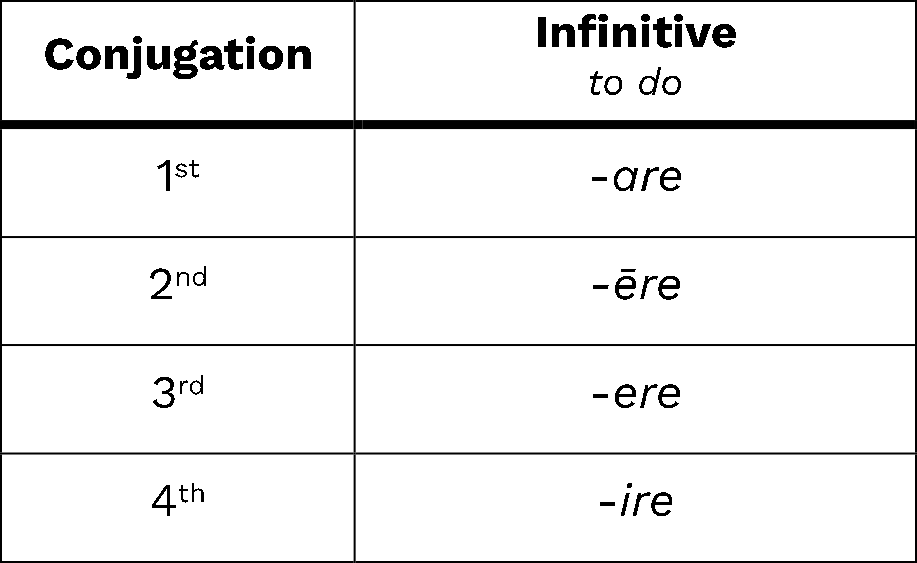
As each conjugation has a different infinitive ending, the infinitive of a verb is often given in Latin dictionaries and vocabulary lists to tell you which conjugation a verb belongs to.
For example:
porto, portare - I carry, to carry (1st conjugation)
video, vidēre - I see, to see (2nd conjugation)
mitto, mittere - I send, to send (3rd conjugation)
audio, audire - I hear, to hear (4th conjugation)